Friday, October 26, 2007

Internet Muscles In on Cell Phone Turf


Having emerged as a popular technology for making phone calls—often free of charge—via one's PC, voice over Internet protocol (VoIP) is set to stake its claim on the mobile market. Mobile VoIP may not replace cell phones in the immediate future, but it will give callers the ability to bypass cellular networks wherever they have access to a Wi-Fi network.

Luxembourg-based Skype, Ltd., a division of online auctioneer eBay, has been pushing over the past year to deliver more of its VoIP services to mobile callers through a partnership with wireless network equipment maker NETGEAR, Inc. A year ago, the two companies teamed up to offer the Skype Wi-Fi mobile phone, which lets callers make free Internet calls to anyone who also has a Skype account and access to a Wi-Fi wireless Internet connection. The phone does not require a cellular network but it must be within range of a Wi-Fi access point to operate.

Skype is now reportedly planning to expand mobile VoIP technology through a partnership with Hutchison 3G UK, headquartered in London and more commonly known simply as 3. A Skype spokesperson confirmed that the company is "working with 3 to make Skype completely mobile," but refused to give details of the deal.

Mobile VoIP phones have thus far made sense in relatively stationary wireless environments, such as homes, offices or Internet cafés. The emergence of mobile VoIP phones changes the dynamic in the communications-provider market, taking away some of the cell phone carriers' power to charge by the minute. Still, mobile VoIP phones are not in a position to render cell phones obsolete, particularly because Wi-Fi signals cannot provide outdoor coverage as well as powerful cell towers do.

There are cordless phones that offer dual access to phone and Ethernet lines, but Skype's model poses the greatest threat to phone carriers such as Verizon and Sprint. This is because it takes customers completely away from using cell networks, which bring in a substantial chunk of carriers' profits. "Skype is the most disruptive model for the carriers," says Bill Kish, chief technical officer and co-founder of Ruckus Wireless, a Wi-Fi hardware and software maker in Sunnyvale, Calif.

The emergence of sophisticated mobile devices such as Apple's iPhone will further drive the demand for more comprehensive Wi-Fi coverage. "The iPhone has a proper browser, but you don't want to be surfing over a cellular network," Kish says. "Wi-Fi was designed from the start to handle data, whereas cellular networks were built for voice."

Some carriers have begun to recognize the disruptive nature of mobile VoIP. In late June, T-Mobile USA launched its HotSpot @Home service that works with new Samsung and Nokia mobile phones to let customers use a single phone for both Wi-Fi and cellular calls. This allows T-Mobile HotSpot @Home customers to switch to the company's cellular network when they leave the range of their home Wi-Fi hookup.

The price is right, says Michael Gartenberg, a wireless technology analyst for JupiterResearch, although he notes that ultimately it comes down to service and quality: "If you can't hear the other person," he says, "it doesn't matter how cheap it is."

Motorola progress on mobile operations

Motorola managed to climb back into profit in the third quarter – its first quarterly profit this year - and signalled progress in its efforts to turn around its struggling mobile phone operations despite continuing market share losses.

Third-quarter profits fell by 94 per cent to $60m, or 3 cents a share, compared with $968m, or 39 cents a share a year earlier. Revenue fell by 17 per cent to $8.81bn. But Motorola's shares gained about 5 per cent in early trading as investors took comfort from a more positive outlook that beat Wall Street expectations.

The company said it now expected earnings from continuing operations of 12 cents to 14 cents a share in the fourth quarter compared with the 10 cents a share that analysts were expecting. "The third quarter was about progress," Ed Zander, Motorola’s chief executive, told analysts in a conference call but added, "we also recognise there's a lot of work to do."

The Illinois-based company and Mr Zander have been under pressure after misreading the market and relying too heavily on sales of the ageing Razr phone for too long. Since the start of the year Motorola has cut costs aggressively and has rolled out a series of new handsets in an effort to turn the mobile phone operations around amid heightened competition.

The latest results which included slight gains in profitability and average handset selling prices, coupled with a rosier fourth-quarter forecast, should ease pressure on Mr Zander who has faced calls from some shareholders for his resignation despite surviving a proxy battle launched by Carl Icahn, the Wall Street investor.

In the third quarter, Motorola shipped 37.2m handsets and revenues in the mobile-device unit fell by 36 per cent to $4.45bn. The segment lost $248m, compared with year-earlier earnings of $843m. Motorola said in July that it did not expect the unit to be profitable by year-end, although it did expect financial results to improve during the second half of the year and has said it will be profitable again next year.

Motorola's share of the global handset market is estimated to be 13 per cent, down 50 basis points from the second quarter, ranking Motorola number three behind Finland”s Nokia which has widened its lead and Korea’s Samsung Electronics which has also been growing its market share. In the latest quarter Motorola continued to lose market share in the Asia Pacific region, including India, but it regained its lead in Latin America and kept its lead in North America.

"We see the industry growing in the double-digit-plus range," said Greg Brown, Motorola's president and chief operating officer. He added the company would be pushing more third-generation, or 3G, phones, as demand increases.

Mobile Business Expo: Microsoft's New Mobile Platform May Be WinMo's Tipping Point


Microsoft has tried to make Windows Mobile the default standard for business mobility for over four years now. Yet, Microsoft is only on track for 20 million phone units worldwide. That's a drop in the bucket compared to the global market of 1.2 billion handsets that are expected to ship this year.

Initially, almost all the market analysts I knew thought long ago Windows Mobile would kill its competitors, especially in the business market. And while Windows Mobile has taken off with vertical markets, it's still far from the global gold standard.

I noticed with the last upgrade of Windows Mobile that Microsoft stopped talking about mobile e-mail and started stressing its platform. This indicates Microsoft's strategic shift. And despite some amusing confusion with branding, Microsoft is no longer trying up sell Windows Mobile on the back of Exchange. It's trying to offer Windows Mobile as a part of a comprehensive device management solution.

Microsoft's new platform, called System Center Mobile Device Manager (OK, so it won't win any awards for creative naming), takes the emphasis off e-mail and puts in on three areas: device management, transport, and security. Guess what, these are areas that Microsoft can win in.

It also recasts smartphones and mobile devices in the mode of laptops and not wireless handsets. Why is this important? It allows Microsoft to sell to CIOs on terms with which both IT managers and Microsoft are comfortable. In short, Microsoft isn't trying to replace RIM. It's trying to recast mobile as an IT issue, not a carrier issue that IT managers pay others to manage for them.

It also shows that Microsoft is serious about winning the device management sector. Device agnostic mobility platforms like Sybase iAnywhere, Smith Micro, and Odyssey Software should be scared. Startups like Mformation should be really, really scared.

As I have pointed out on this blog before, device management has emerged as the next competitive battleground for business mobility. While services like mobile e-mail become a commodity, device management will be the differentiator.

Can Microsoft use device management to win the business mobility market? Or will Windows Mobile continue to limp to mediocrity?

Sunday, September 23, 2007

Mobile TV draws billions


Global annual consumer spend on mobile broadcast TV services is expected to exceed �3.28 billion by 2012, according to Juniper Research. Nearly 120 million mobile users in more than 40 countries are expected to receive broadcast TV services by 2012, compared to less than 12 million in 2007, with
DVB-H the dominant transmission standard.

However, the Juniper report cautions that services face significant technological and regulatory hurdles, both
prior to launch and as they attempt to build a mass of subscribers.

Report author Windsor Holden stressed the need for broadcast TV chipsets to be rapidly introduced into a wide range of mass-market handsets to increase take up of the service.

Holden said: “If companies are serious about achieving widespread adoption of mobile TV, it is essential for chipsets to filter down very rapidly from top of the range
Handsets into the mass market models so that everyone has the opportunity to sample mobile TV services.”

Samsung, Giorgio Armani team up to develop TVs and mobile phones


Samsung Electronics said it agreed Sunday to develop new premium electronic products with Italian luxury goods designer Giorgio Armani.

Under the business tie-up the two firms would jointly develop mobile phones, flat-screen televisions and other electronic products, it said in a statement.

The "Giorgio Armani-Samsung luxury mobile," the first of the jointly-developed products, will be unveiled during a Giorgio Armani fashion show in Milan, Italy, on Monday, it said.

An "Armani/Casa-Samsung luxury LCD television" under joint development was also ready to be unveiled in January 2008, it added.

"This powerful partnership will match great design with leading technology to ensure performance is as impressive as appearance," said Yun Jong-Yong, vice chairman of Samsung Electronics.

South Korea's LG Electronics has already teamed up with Italian luxury goods designer Prada to develop a mobile phone.

Friday, July 20, 2007

Color Your iPhone and Your World

Colored_iphone

The iPhone looks great. Everybody agree on that. But it's available in one and only one color. And in a world where "being unique" is almost the ultimate life achievement you can't take the chance to become like everyone else once again. The problem is that the iPhone will rapidly become something everyone has (at least Steve Jobs hope so!).


But don't be scared to become like everybody else in the near future! ColorWare is offering to color your iPhone in 29 different colors. It won't add any new features to the precious gadget and it won't make AT&T Edge network faster, but it will make your iPhone even more cool than it is right now (can it be more cool?).

Having the iPhone in a different color is not enough? Well, add up to four different colors to your iPhone. You can select different colors for the front button, the chrome rim, the back and even the center logo.

The company says, "It's up to you whether you want something out of this world or something subtle and sweet like an all white iPhone."

But a personalized iPhone has a price though. Pricing starts at $149 for the coloring service and the price will go up rapidly depending on the number of colors you would like to have on your iPhone.

Let us know if you plan to use this service, we would love to receive pictures of your newly colored iPhone.

Monday, July 16, 2007

Skype for Pocket PC 2.1 Beta


Great news, a new version of Skype for Pocket PC is now available, which you can download from here or before you do that, why not find out a little more about the cool new features and some great ways to get the most out of Skype on a Pocket PC.

Key features in Skype for Windows Mobile 2.1 beta

Skype calling features: Skype main calling features are supported including free Skype calls, support for SkypeOut™, SkypeIn™, voicemail and call forwarding.
Improved look and feel: As easy and familiar as using Skype on a computer, the new Skype for Pocket PC includes an enhanced SkypeOut dial pad for Pocket PC devices;
One click Skype access: A Skype icon on the device home screen allows you to view and call contacts much more easily;
Multi-person chat: You can now have multi-person chat sessions using animated emoticons with colleagues, friends and family and when you’re offline, chat messages will automatically update the next time you log in;
Enhanced contact list: See your contacts’ avatars and mood messages; and
Profile personalization: Take a picture with the camera on your device and immediately update your profile.

Great reasons to use Skype on a Pocket PC device
You don’t have to be in front of a computer, carry your laptop or wait for it to boot to make Skype calls. Skype for Pocket PC gives you the freedom to make free calls anywhere. All you need is a Pocket PC and a high speed wireless internet connection. Here’s just a few ways that it can make your life easier.

Whilst Abroad: Avoid expensive mobile phone bills while roaming. Check your hotel offers free or low cost WiFi and stay in touch with work, friends and family by connecting to Skype in your hotel or any public WiFi hotspot. Most airports also offer WiFi, so stay connected to your Skype contacts on the go. With SkypeIn, people back home can call you on your Windows Mobile phone paying local rates too.

In your home: Bad reception on your mobile at home? Take advantage of your home broadband connection (make it WiFi) and use Skype for free. Get a SkypeIn number and people who aren’t on Skype can call you on a regular landline number. Alternatively, where your PC is in the study or a different room, Skype for Pocket PC gives you the freedom to talk for free, chat anywhere in your home.

On a train or plane: You can even get WiFi on some trains and planes, so connect to the network and make free Skype calls whether you’re under a tunnel or in the air.

Living in or visiting the USA? Make free calls to landlines and mobiles in the US and Canada whenever you have WiFi access Also, why pay to receive calls on your US mobile? Get a US SkypeIn number here and receive calls for free whenever you have WiFi coverage.

Pocket PC devices that support Skype
Skype runs on most Pocket PC with a minimum 400Mhz processor with a high speed internet connection over WiFi or 3G.

A list of popular device that support Skype can be found here

Feedback
I hope that this was useful and please be sure that the Skype for Windows Mobile team are working hard to make this product even better.

We’re really interested to know what you think about this latest version - what we’re doing well and what we could do better, so do let us know what you think by visiting our Pocket PC Beta area.

Sunday, July 15, 2007

VoIP comes to the iPhone

I want an iPhone, and I’ve got every materialistic reason to demand it. It’s everything iTunes and a fifth generation iPod is, and you can even make and receive calls with it! Add the fact that it’s one of the best multimedia cell phones out there, with looks to die for and connectivity that screams ‘Let’s go,’ and probably you’d want one too. If you do, here’s one more reason for you to have it, and if you don’t, here’s a reason why you might change your mind and end up buying this little new gizmo – VoIP is coming to the iPhone!

Collaboration and Conference provider Genesys has announced that their Genesys Meeting Center 4.0 will be the first VoIP-enabling utility for the iPhone. The Genesys Meeting Center will work via the iPhone’s Safari browser, and will enable all features regularly viewable on a desktop during a web meeting on the iPhone, with complete zooming and portrait/landscape capability. Genesys has announced that the Genesys Meeting Center, which already supports SoftPhone Capabilities, will be compatible with Publisher, Meeting Launcher, Outlook Calendar, and Outlook & Lotus Contacts Control. Complete VoIP on the move – now that’s something.
The iPhone comes with a heavy price tag (US $499 for the 4GB Version, and US $599 for the 8GB one).

That’s one of the reasons why I’m still wishing for an iPhone and don’t actually own one. While the availability of VoIP will not exactly make people discard their previous multimedia smart phones and communicators, it will definitely contribute to the bigger picture of the iPhone hype by adding to its long list of multimedia and communication capabilities.

Is the game worth the candle? I don’t know. Will VoIP be the clinching factor that will make Apple more millions than it’s already making? I don’t know that either. But you know what? I still want an iPhone.

This post is written by Samarth chandola, our full time VOIP news editor.

Saturday, July 14, 2007

NTT DoCoMo Begins Super 3G Experiment

[NTT DoCoMo announces its begn testing its Super 3G system. The highly advanced version of HSDPA and HSUPA technology seeks to achieve a downlink rate of 300Mbps.]
NTT DoCoMo, Inc. announced that this month it began testing an experimental Super 3G system for mobile communications. With this experiment, DoCoMo will seek to achieve a downlink transmission rate of 300Mbps over a high-speed wireless network.

Super 3G features low-latency data transmission and improved spectrum efficiency. It is a highly advanced version of High-Speed Downlink Packet Access (HSDPA) and High-Speed Uplink Packet Access (HSUPA), which have been evolved from W-CDMA packet transmission technologies standardized by the 3rd Generation Partnership Project (3GPP). The 3GPP, a telecommunications standards organization, is currently discussing standardization of Super 3G under the name Long Term Evolution (LTE).

DoCoMo will begin with an indoor experiment to test transmission speed using one transmitting and one receiving antenna. The company will then expand the experiment to examine downlink transmission by employing up to four Multiple-Input Multiple-Output (MIMO) antennas for both the base station (transmission side) and mobile station (receiving side); the goal is to achieve a downlink transmission speed of 300Mbps. MIMO is an antenna technology for wireless communications in which different data streams are spatially multiplexed using multiple antennas for both transmission and reception on the same frequency. Also to be examined is the "handover function" switching of the connection between two base stations.

DoCoMo will also examine the functionality of applications for voice and image transmission, games and the like, key capabilities impacting the Super 3G system's marketability.

DoCoMo, aiming to achieve sustainable, efficient use of 3G spectrum resources, is leading the discussion over LTE. DoCoMo believes Super 3G will allow the company to make a smooth transition to 4G in the future.

In July 2006, DoCoMo began accepting proposals from suppliers seeking to develop Super 3G equipment and expects to complete development of Super 3G technology by 2009.

Nokia announces three new Bluetooth Headsets


Nokia, the global leader in mobility, today announced three new Bluetooth Headsets; the elegant and lightweight Nokia Bluetooth Headset BH-700, the classic feature packed Nokia Bluetooth Headset BH-600 and the sleek Nokia Bluetooth Headset BH-300.

These three new headsets are the latest confirmation of Nokia's innovative approach to Bluetooth headsets. All three Nokia Bluetooth Headsets are planned to be commercially available during the summer of 2006. The estimated retail prices (excluding taxes) for the three headsets are 50-60 EUR for the Nokia Bluetooth Headset BH-300, 60-70 EUR for the Nokia Bluetooth Headset BH-600 and 70-80 EUR for the Nokia Bluetooth Headset BH-700.

Nokia Bluetooth Headset BH-700

Weighing only 10 grams, the Nokia Bluetooth Headset BH-700's simple and elegant form factor offers the ultimate in freedom and comfort when used with a compatible mobile device. With talk time of up to 6 hours and up to 160 hours of stand by time, the Nokia Bluetooth Headset BH-700 provides a hassle-free and long-lasting communications experience. The power button, volume control and call answering buttons make it easy to handle calls.

Nokia Bluetooth Headset BH-600

Nokia Bluetooth Headset BH-600 is a classic, comfortable and easy to use headset that provides excellent audio quality even in noisy environments due to digital signal processing (DSP). The Nokia Bluetooth Headset BH-600 has a talk time of up to 7 hours and up to 170 hours of stand by time and weighs 18 grams.

Nokia Bluetooth Headset BH-300

The sleek minimalist styled Nokia Bluetooth Headset BH-300 is an easy-to-use wireless headset with comfortable user changeable ear loops. Weighing only 10 grams, it completes the Nokia Bluetooth headset trio with very user-friendly functionality and a feeling of simplicity. It has talk time of up to 5 hours 30 minutes and up to 150 hours of stand by time.

Thursday, July 12, 2007

Mundu IM: Mobile Instant Messenger (Win Mobile) 4

Mundu IM all your buddies on MSN, Yahoo, ICQ, AOL, Google Talk and Jabber on your Windows Smartphone from one single user interface. There is no cost per message. Mobile data plan required. You can carry out a host of real-time, important activities such as photo sharing and file transfers, cross-conferencing and dynamic group management. You can also do cool stuff like share photos through the application; express yourself better with Rich Text and status-customization.

Version 4 adds photo sharing & file transfer; E-mail notifications on Yahoo, MSN, and Google; Multi-lingual chat & message archiving.

Download now

Publisher:

Geodesic Information Systems

Tuesday, July 10, 2007

Nokia E65 - The Business Solution


Business solution from Nokia are long known for their user friendliness and a nice bundle of features. Their popularity can be easily gouged by the fact that the business centric E series has sold more number of handsets than any other business phone series. The Nokia E61 is a member of this reputed family of business phone. The qwerty keypad laced smart business phone is aimed at further strengthen their business portfolio.

The Nokia E61 is an ideal device for professional on the go. This silver coloured smartphone is S60 platform based and Symbian OS 9.1 operated. The PDA styled smartphone features a full QWERTY keypad which has a tactile feel to it. This addition is very natural for a device optimized for mobile email. Infact, the Nokia E61 has a unique email indicator so that you could be notified the instant you receive an email. The large 16 million coloured TFT screen is ideal to read mails and documents as well as work on large spread sheets.The handset has a dedicated email key for instant access to your email client. This multi tasking device allows you to send and receive emails while you're still on a call. With the Nokia E61 you can continue reading or writing emails even in absence of network in offline mode. Use the Nokia E61 to read as well as edit attachments sent with your Mobile Phones email. The smartphone supports the most common features of Microsoft Word, PowerPoint and Excel and is compatible with Zip Manager and Adobe Reader.

Connectivity potentials of the O2 Nokia E61 are immense. The handset supports quad band GSM mobile network and includes truly advanced voice services. Data connectivity through GPRS and EDGE of the handset is no match for the 3G technology embedded. In UMTS networks, the Nokia E61 can achieve data speeds of up to 384 kbps. Other connectivity options includes Bluetooth, Infrared, USB and WiFi that could be used for VoIP over WLAN.

From :
- Nokia O2 Mobile Phones.

Saturday, July 7, 2007

VoIP Security: Who Will Be The Next T-Mobile?

Today's hot topic is VoIP security and while there haven't been any huge break-ins into VoIP systems that I am aware of I am aware that according to the WSJ, T-Mobile recently had their computers broken into and customer names and social security numbers were accessed. The bold section below doesn't sound too good but I must admit I slept through much of history class so if there was a day we went over "mutual assistance legal treaties," I was either dreaming or absent.

Nonetheless we seem to have one of these with Russia. Who would have guessed? Here is an excerpt from the story:

Hacker Breaks Into T-Mobile Network

By JESSE DRUCKER and JOHN D. MCKINNON
Staff Reporters of THE WALL STREET JOURNAL
January 13, 2005; Page B5

A hacker broke into the computer systems of T-Mobile USA Inc. over several months, viewing the names and Social Security numbers of 400 customers as well as the files of a Secret Service agent investigating the network break-in, the company and government officials disclosed.

According to the Associated Press, the hacker obtained an internal Secret Service memorandum and part of a mutual assistance legal treaty from Russia. The documents contained "highly sensitive information pertaining to ongoing ... criminal cases," according to court records reviewed by the AP. The hacker also accessed e-mails and computer files.

The break-in was discovered during a broad Secret Service investigation, called "Operation Firewall," that targeted underground hacker organizations.

Nicolas Lee Jacobsen, a 21-year-old computer engineer of Santa Ana, Calif., was charged with the break-in in U.S. District Court in Los Angeles.

Deutsche Telekom AG's T-Mobile, the country's fifth-biggest cellphone-services provider with more than 16 million subscribers, said that its systems were broken into in late 2003. The carrier said it notified the Secret Service, which apprehended Mr. Jacobsen in late 2004. According to the AP, court records said the hacker had access to T-Mobile customer information from at least March through October of last year.

T-Mobile said the customers whose records were viewed were notified in writing, but said that customer credit-card information wasn't accessed.

"This same person is also believed to be involved in other attempts to gain unauthorized access to customer information," a T-Mobile spokesman said in a statement. "The Secret Service is investigating these allegations, and T-Mobile is cooperating to the fullest extent, including with regard to the allegations that customer photos have been subject to unauthorized access."

Will this happen to VoIP at some point? Will conversations be hijacked? Absolutely in my opinion. Somewhere out there, an army of hackers is salivating at the chance to listen in as you call Dominos and order your pepperoni pizza. Once we open up telephony by pushing it over IP packets we need to make sure we are 100% dedicated to ensuring VoIP security. Service providers need to understand how important it is to focus on this issue because who knows what "treaty-talk" could be going on over those packets.

Wednesday, July 4, 2007

fring now supports Windows Mobile 5 and 6

Welcome users of about 300 Windows Mobile handsets and PDAs!

fring for Windows Mobile 5.0 & 6.0 handsets works just like our Symbian for Nokia version with:
• Full fring mVoIP functionality – free calls, chat & presence over any Wi-Fi, 3G or GPRS connection
• fring, Skype, Google Talk, MSN & GSM buddies in one integrated contact list
• twitter support
• Skype-out & hundreds of SIP providers supported
• Turn your SIM–less, Wi-Fi enabled PDA into a mobile phone

Monday, July 2, 2007

Which Mobile VoIP to Choose?


Question: Which mobile VoIP client will end up the winner? Answer: What do you mean by mobile VoIP client? Is it software that lets you make VoIP calls via your cellular data service? That lets you make WiFi calls using your dual mode handset? That lets you initiate cellular calls that end up being delivered over the Internet? Or some or all of the above? You see the problem. At present, mobile VoIP is more a marketing term than a specific service or technology.


The purest form of mobile VoIP travels over IP links all the way to the handset. Usually this requires a 3G-speed cellular data service (and a cellular carrier that doesn't prohibit it). It also requires a soft client that works on the particular handset in question, which at present limits the number of phones you can use. Two obvious examples are Fring and Skype Mobile, Raketu plans to come out this month with a mobile client that will work at less than 3G data speeds. Either way, your choices are limited.

Those clients also support VoIP calls made through wifi hotspots using dual mode cellular/wifi handsets. Other clients for such handsets similarly support VoIP calls over wifi, but not over cellular data networks. In that case, all calls made out of hotspot range have to travel over the cellular voice network. Whether that qualifies as true mobile VoIP is again a matter of definition. Truphone is a high-profile example of this approach.

The possible combinations of software, service models and transport methods are almost limitless. Some services, for example, use clients running on handsets, and VoIP switching, but mainly transport their calls over the PSTN. Others do without the client, but deliver their calls over the Internet. No two contenders take exactly the same approach.

ISkoot is one that uses client software on the handset along with VoIP transport, specifically by delivering mobile calls to Skype. The client reaches out over your cellular data network to set up calls, and connects you to the Skype network via a local call from your phone using your cellular air time. You pay for SkypeOut and SkypeIn services like you would if using them from your PC. For now, iSkoot isn't charging for connecting you to Skype. (It also has a Fring-like dual mode product in beta.)

Mino Wireless also uses client software to set up calls, though you can use your handset's Web browser to go to their site and get the same result. Mino's service initiates calls to your cellphone and to the number you're trying to reach, then connects them in the middle. It uses a combination of conventional telecom carriers and IP infrastructure to carry the calls great distances at low prices.

GrandCentral Mobile, by contrast, is mainly an alternate method of accessing the main GrandCentral service. That service provides the Web-based call management features and flexibility of VoIP, but all calls start and end on the public wire line or wireless networks. The mobile version merely lets you access key features through a handset, and it requires no client software. You simply use your handset's browser to log on to the GrandCentral mobile site. Once there, you can see your voice messages listed, click to listen and call, change your forwarding number, and the like, all through your phone's tiny keypad and LCD screen.

Companies like Jajah, Rebtel, Eqo and others each mix the various ingredients in different ways. So to return to the question of which mobile VoIP will prevail in the future, the answer becomes clear. It will be the one that lets you make cheap mobile calls, with all the flexibility and convenience that VoIP offers, without having to know any of the details you’ve just read.

Source and more info: www.voip-news.com

Skype Mobile VoIP for your Palm TREO by EQO

EQO Communications announced immediate availability of EQO Mobile for Skype on the Palm TREO 650 and Motorola ROKR, SLVR, and RAZR handsets. With this announcement, made at the CTIA Wireless 2006 conference, EQO brings the number of EQO-supported handset models to more than 45 and finally, PalmOS community can put the Skype petition into reset, EQO Communications Mobile Instant Messaging for Skype is now available for download for Palm Treo 650 smartphone users.

Skype Mobile VoIP for your Palm TREO by EQO


"We've built a platform and a solution that is both flexible and adaptable," said Colin Quon, Founder and CTO of EQO. "This enables us to respond quickly to customer demand in expanding support for new and popular phone models as they hit the streets."

EQO uses a small amount of data traffic on your mobile phone so you may wish to consult your wireless service provider about an appropriate data services plan using GPRS. EQO Mobile for Skype lets users make and receive calls, send Instant Messages, and view presence information about their buddies over the Skype network. It is available for free to consumers as a Beta product via the EQO (pronounced "echo") web site at eqo.com

Useful Feedback from users that have already installed it on their Treos:

1. The Mobile App. UI needs lot of improvements. Specially the standard Palm OS Edit functions should be provided (Cut, Copy, Paste).
2. Need to have support for 5-way navigation pad for the two buttons on the bottom of the screen. It is very annoying to press screen and then use the 5-way pad for other functions.
3. The screen keeps flickering on some views. Do not know why.
4. The Call # screen needs much improvement. The first digit you enter appear off the input window.

Skype 3GSM news including Skype Mobile on the HP hw6900


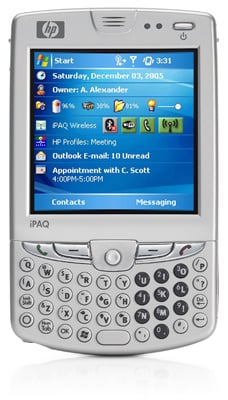
Some Skype news from the first day of 3GSM in Barcelona that a Skype PR representative shared with me. First, HP is announcing that the new HP iPAQ hw6900 supports Skype Mobile for Pocket PC. The hw6900 looks just like the hw6515 that I drooled over, with a 240x240 TFT screen and integrated keyboard. The hw6900 is a bit heavier(6.33 oz vs. 5.8 oz) but it also sports a more powerful 416Mhz processor (the hw6515 has 312Mhz) which will certainly assist the Skype application, which can use all the processing horsepower it can get. The hw6900 also runs the latest Windows Mobile 5.0 operating system.

Secondly, Skype announced a new retail program, with Dangaard Telecom in Europe, giving Skype Certified products the potential to reach shoppers across more than 34,000 European retailers, who will initially include Mediamarkt, Media-Saturn, Merlin, Dansk Supermarked and Surcouf. Lastly, SkypeIn is now available in Korea. Now I'm drooling over the hw6900

Saturday, June 30, 2007

AT&T Will Offer Three iPhone Service Plans


According to Current Analysis analyst Avi Greengart, AT&T's unlimited-data service plans for Apple's iPhone are "quite reasonable" in that they cost only about $20 more than the equivalent voice-only plans from other providers. "From the consumer's point of view," he said, AT&T's approach to unlimited data on the iPhone is "extremely positive."

Lest you thought the iPhone could get by on looks alone, Apple and AT&T have formally released three service plans for the Friday launch.

The iPhone-specific plans all include unlimited data for e-mail and Web, Visual Voicemail, 200 text messages, rollover minutes, unlimited mobile-to-mobile calling, as well as varying amounts of phone minutes.

The three iPhone plans are $59.99 monthly for 450 minutes and 5,000 night-and-weekend minutes, $79.99 for 900 minutes and unlimited night-and-weekend, and $99.99 for 1,350 minutes and unlimited night-and-weekend.

There is also a one-time activation fee of $36, and users must sign up for a two-year contract.

Boingo to Roam onto FON's Wi-Fi Network


Boingo Wireless Inc., the world's leading wholesale network aggregator and operator of neutral-host Wi-Fi networks, today announced it has signed a roaming agreement with FON, a Madrid-based company, that, when integrated, will provide access to an additional 130,000 hot spot locations -- more than doubling the company's network size.

The 130,000 Wi-Fi locations come from businesses and individuals who add their own hot spots to the FON community in exchange for the right to roam on other FON community locations for free or at a reduced rate. For Boingo users, these new locations provide a rich network of Wi-Fi locations in areas that complement Boingo's existing commercial locations.

Access to the FON network will also benefit users of Boingo Mobile, the company's service for Wi-Fi-enabled handsets. Boingo Mobile users pay $7.95 per month for unlimited access to hot spots worldwide to make VoIP calls, use messaging services or surf the Internet from their handset.

FON hot spots are provided by community members (called Foneros) who share their unused bandwidth via a FON router in exchange for free Wi-Fi access when roaming through any other FON access point. FON recently signed a partnership with Time Warner Cable, to give their cable modem service subscribers the opportunity to be members of the FON community and enjoy free unlimited Wi-Fi access at any of FON's partner ISP Wi-Fi hotspots.

Skype partners with Wal-Mart in bringing VoIP to the masses

San Jose, CA -- Starting today, Wal-Mart is offering Skype Certified(TM) hardware in the Internet and voice communications area of 1,800 of its stores throughout the country, providing more opportunity and accessibility for people looking for affordable calling options. This partnership gives shoppers immediate hands-on access to headsets, webcams and handsets designed to work with Skype, as well as the first pre-paid cards for Skype available in the U.S. The addition of Skype Internet communications products to Wal-Mart stores comes at a time when Voice over Internet Protocol (VoIP) adoption among U.S. households is growing rapidly. According to the Telecommunications Industry Association, 9.9% of all landlines in the U.S. were VoIP lines in 2006, and this will rise to 34.1% by 2010. In addition, Skype is the number one software-based VoIP application in the U.S. by market share, according to a March 2007 report by In-Stat.

"We applaud Wal-Mart for recognizing the popularity of Skype and making it more accessible to Wal-Mart shoppers. This relationship with Wal-Mart will increase exposure for Skype and our hardware partners in a single dedicated Internet communications section," said Don Albert, vice president and general manager of Skype North America. "Our research suggests that when users add a Skype Certified accessory like a headset, handset or webcam, it greatly enhances their experience and they use Skype more to connect with family, friends and business colleagues."

Today, Skype is enjoyed by more than 196 million registered users around the world. Users download Skype software to make free voice and video calls and send instant messages over the Internet. Skype also offers paid-for products which let users make, receive and forward calls to and from landlines and mobile phones. To enhance the Skype user experience, hardware devices and accessories are available from approximately 50 leading manufacturers. These products certified by Skype give users the additional flexibility to talk more freely and naturally when placing Skype Internet calls.

"We have taken a sharp focus to launch the products and brands that consumers are moving toward at the most affordable prices," said Kevin O'Connor, vice president and general merchandise manager, Wal-Mart Electronics. "The Skype hardware and pre-paid cards are a great fit with Wal-Mart because they offer long-term money-saving solutions at the right time for many customers -- parents, grandparents, college students and military families."

Wal-Mart is the first and currently only retailer in the U.S. to offer Skype's pre-paid cards. Shoppers can purchase a $20 pre-paid card and redeem it for Skype credit to make inexpensive international calls at rates as low as 2.1 cents per minute. Another pre-paid card is available in stores for a three-month subscription to the Skype Unlimited Calling Plan for just $8.85. This gives consumers three months of unlimited Skype calls to any landline or cell phone number in the U.S. and Canada.

Up to nine different Skype Certified hardware products are available within branded Skype Internet Communications sections within Wal-Mart stores' electronics department. Shoppers will find Skype certified headsets under $15, webcams under $25 and handsets under $30 from quality brand names such as Plantronics, Philips, Logitech and more. The relationship with Wal-Mart represents the first time a retailer is bringing together Skype Certified hardware and pre-paid cards for Skype under one dedicated section.

T-Mobile’s Hotspot@Home Going Nationwide This Week?

“The Boy Genius Report says it has seen documents that suggest the launch will occur on June 27,” smartphonetoday recently reported on its website. However, T-Mobile USA is being tightlipped on the matter.

The new wireless service, which underwent trials in Seattle for longer than a year, lets T-Mobile’s subscribers make free phone calls using their at-home WiFi (News - Alert) network or from any public WiFi hot spot.

Earlier, subscribers using the Nokia 6136 and the Samsung T709 dual mode phones could only place free calls over WiFi. T-Mobile has since moved to the newer Nokia 6086 and Samsung (News - Alert) t409 for HotSpot @Home.

According to news reports, T-Mobile HotSpot @Home costs $20 a month on top of your regular cell phone plan. It delivers unlimited Voice over WiFi calls from over 8,000 hotspots as well as your home through a WiFi access point.

As the service is based on Unlicensed Mobile Access (UMA) technology, it allows users seamlessly switch voice calls and data connections between a WiFi and cellular, depending on which is available and which is most cost effective at a particular moment.

Another advantage for users is that once they are in a hotspot, they gain access to a higher speed network, which allows them to download mobile content including Web pages, music files, video files, and games - much faster than they can from a 2G, or even 3G wireless networks.

Source and more info: tmcnet

VoIP Phone Maker snom Teams with SOA Specialist BlueNote Networks

VoIP phone manufacturer snom technology AG and SOA-based business communications solutions provider BlueNote Networks (News - Alert) announced on Monday a strategic partnership. The two companies are, after extensive certification procedures, are now marketing solutions involving BlueNote’s SessionSuite software and snom’s VoIP phones, which are proven interoperable.

Alan Rosenberg, director of product management at BlueNote, said that the company’s customers are accustomed to flexible solutions that are easy and fast to deploy. This partnership with snom extends that winning recipe by ensuring that BlueNote solutions work with snom’s entire product line.

“Now, we can easily incorporate snom phones into our overall solutions,” Rosenberg said in a statement.

That product line includes all of snom’s telephones, including the 300, 320, 360 and 370 models. Each of these products is designed easy configurability and manageability—using a keypad-cursor, dedicated function keys and menus, or Web browser. The phones include user-friendly features such as programmable keys and downloadable ringtones.

Further, the phones comply with the IETF’s latest recommendations for authentication and security using industry standards.

These phones can now be paired with BlueNote’s SessionSuite family of solutions, which are designed to integrate voice, video and other interactive communications functions with business applications using Web services. These solutions help improve collaboration, productivity and business agility.

Friday, June 29, 2007

Skype highlighted in rising supply

April 2007 Telecom Products 45 The popularity of Skype among VoIP users worldwide is fueling makers’ adoption of the application for DECT VoIP phones. Makers in Hong Kong, which emphasize peer-topeer (P2P) application support, are centering their R&D and production plans on building Skype into their products.

This, however, does not preclude any growth in the USBbased phone segment. Many makers in mainland China and Hong Kong produce an ample supply of DECT VoIP phones with USB interface. In fact, makers see continuous growth in this sector, as many users worldwide still depend on the PC to place and receive VoIP calls.

Most models currently available support conventional and VoIP phone calls. Makers piggyback on DECT’s capability to enable wireless communication to add value to VoIP phones. Some companies also integrate Bluetooth, and others are considering adding Wi-Fi support.

Source and more info: telecom

The Nokia N80 as a VoIP Phone

Hi-Mobile sent us in the very popular Nokia N80 smartphone. While the phone was released about 10 months ago, just last month there was a brand new and free firmware upgrade that upgrades it to version 4.x which adds VoIP functionality. The upgrade is available for all N80 models, even the ones that were not released under the “Internet Edition” brand. Read more for our test.

The N80 is a quad-band GSM/EDGE and European UMTS smartphone running the Symbian 9.0 OS with the S60 3.x front-end. It features an impressive 2.2″ TFT screen with the 352×416 resolution, it supports miniSDs and has 40 MBs of internal memory free. It features Bluetooth 1.2, an IrDA port, WiFi, FM Radio, PTT, a CIF video call front camera and a 3.2 MP camera with flash.

The device does not weigh much and it feels pretty good in the hand, although it could have been thinner. The slider mechanism is not very good, I kept pressing keys by mistake while trying to slide the phone up. One other thing is that the camera is more exposed than usual and so if you leave your phone in a rough place you can seriously scratch the lense. Having said that, the overall construction of the device is very good and pleasant. In the box there was a charger, a handsfree stereo headset, a 512 MBs miniSD and a USB cable.

Source and more info: osnews

EarthLink To Unveil WiFi Phone Beta

EarthLink is expected to announce a beta test for Accton Technology Corp’s WiFi phone as early as tomorrow. Beta testing on the phone has been in the works on EarthLink’s municipal wireless network in Anaheim and it seems to be working very well. Like any WiFi phone, you’ll be able to make VoIP calls from your home network or on EarthLink’s Municipal WiFi network. As soon as you power on the phone you’ll be able to make quick and cheap phone calls over the internet without sacrificing voice quality.

Source and more info: crunchgear

Thursday, June 28, 2007

The Apple iPhone


Capping literally years of speculation on perhaps the most intensely followed unconfirmed product in Apple's history -- and that's saying a lot -- the iPhone has been announced today.
Yeah, we said it: "iPhone," the name the entire free world had all but unanimously christened it from the time it'd been nothing more than a twinkle in Stevie J's eye (comments, Cisco?). Sweet, glorious specs of the 11.6 millimeter device (that's frickin' thin, by the way) include a 3.5-inch 480 x 320 touchscreen display with multi-touch support and a proximity sensor to turn off the screen when it's close to your face, 2 megapixel cam, 4GB or 8 GB of storage, Bluetooth 2.0 with EDR and A2DP, WiFi that automatically engages when in range, and quad-band GSM radio with EDGE. Perhaps most amazingly, though, it somehow runs OS X with support for Widgets, Google Maps, and Safari, and iTunes (of course) with CoverFlow out of the gate.

A partnership with Yahoo will allow all iPhone customers to hook up with free push IMAP email. Apple quotes 5 hours of battery life for talk or video, with a full 16 hours in music mode -- no word on standby time yet. In a twisted way, this is one rumor mill we're almost sad to see grind to a halt; after all, when is the next time we're going to have an opportunity to run this picture? The 4GB iPhone will go out the door in the US as a Cingular exclusive for $499 on a two-year contract, 8GB for $599. Ships Stateside in June, Europe in fourth quarter, Asia in 2008

Google Launches Google News Mobile


Google has announced the addition of Google News to their mobile offerings, bringing the informational goodness of Google News to cell phones, train stations, and waiting rooms all over the country. On the Google News Mobile site Google says that “You can access top headlines, browse through news categories, or search for exactly the stories you want - all in a phone-friendly format that’s easy to read and navigate. All you need is a web-enabled phone.”
Like most Google offerings, Google News Mobile is debuting in Beta mode and also like Google News, Google News Mobile works by sending the end user to sites which are hosted outside of the Google MoBorg - making it a news gateway. Currently Google News Mobile is only available for access to English language news sources, but Google is planning on expansion.
Unlike the desktop browser based version of Google News, Google News Mobile does not list all of the sites in the Google News index.
Instead, Google News Mobile links only to publishers with pages specifically designed for viewing on mobile phones - which is plenty reason for publishers to now offer a mobile friendly version (more info for publishers and indexing their sites in the Google News Mobile FAQ).
If users have a PDA, Smartphone or a phone or mobile device that can view HTML pages, the entire Google News index can be accessed in the same way as the traditional desktop version.
Google News Mobile now joins Google Mobile’s application of search services including Google Local Mobile, Google Search Mobile, Image Search Mobile, SMS and Google Personalized Homepage for the mobile.

Samsung Latest To Unveil WiFi Mobile Phone

Wi-Fi-enabled mobile phones are seen as having potential to spread mobile Web use by giving phone users more options and price points for that connectivity. Wi-Fi could offer a more cost effective way for users to access the Web from mobile devices by minimizing the air time used to go online.

Staking its claim to leadership in the converging worlds of mobile computing, Web browsing and cellular communications, Samsung has become the latest handset vendor to roll out a WiFi-enabled phone.
Samsung said it will make its SPH-M4300 available in its home market of Korea later this month. In addition to being able to access the Web via WiFi Internet connections, the device features a 1.3-megapixel camera and a 2.8-inch LCD and will run on the Pocket PC operating system made by Microsoft (Nasdaq: MSFT) .
Samsung has taken to testing products in Korea before rolling them out onto the worldwide market, something it is eager to do to keep and gain market share in an increasingly competitive environment.

Skype Delivers Mobile VoIP

Skype Technologies has officially launched its VoIP software for handheld devices. Skype for Pocket PC 1.0 lets users of PDAs that have both Wi-Fi wireless local area network connectivity and the Pocket PC OS make unlimited calls from any Wi-Fi hot spot.

Voice over Internet calling is now available for PDA users, with Skype Technologies officially launching software designed for handhelds running the Microsoft Windows Pocket PC operating system.
Initially offered in a beta version earlier this year, Skype for Pocket PC 1.0 lets users of PDAs that have both Wi-Fi wireless local area network connectivity and the Pocket PC OS make unlimited calls from any Wi-Fi hot spot.
The software can be downloaded for free at the company's Web site. Customers are advised to purchase a headset.
First Laptops, Now PDAs
This is essentially a mobile version of the company's global VoIP service based on peer-to-peer software, and also delivers instant messaging without voice over GPRS wide-area networks. Conference calling is also available.
Skype for Pocket PC enables cross-platform voice calls to other Skype users running Skype for Windows, Skype for Linux or Skype for Mac OS X. Among the features are a global directory and end-to-end encryption.
Now that laptops have been VoIP-enabled, PDAs are following suit. SoftAir Microsystems has licensed an application from San Jose, California-based HelloSoft that adds VoIP capability to its line of products for PDAs and notebooks.
VoIP for the Masses
Cisco and Nortel also provide VoIP over wireless local area networks, but using a peer-to-peer connection is a new twist. "Skype is delivering VoIP to the masses," said IDC analyst Alex Slawsby, "providing voice communications on a mobile device or a PC."
Internet calling software for PDAs is a step toward taking greater advantage of Wi-Fi technology in handheld devices, he told NewsFactor. "It will get even more interesting when this is brought to mobile phones, enabling operators to move beyond wide-area networks and into local-area networks," Slawsby said.
Because this software is based on peer-to-peer technology, the service is limited to small groups of users, said IDC analyst Will Stofega. "Who you can talk to is what it's all about, and the big wireless carriers are still working on that."
Stofega compared Skype to VoIP startup Vonage, noting that such companies provide a valuable service by drawing more attention to Internet-based calling and pushing other service providers to explore the technology.

what is fring?


fring™ is a free mobile VoIP software that lets you talk and live chat (IM) using your handset's Internet connection instead of costly mobile airtime (GSM) minutes. fring enables free mobile calls over Wi-Fi Internet access or your GPRS, EDGE or 3G Internet data plan.
fring lets you easily communicate with all your fring, Skype®, MSN® Messenger, Google Talk™ , Twitter and regular phone contacts from one, integrated contact list. fring also supports SkypeOut and hundreds of SIP-based services such as GizmoProject, VoipCheap, VoipStunt, Free World, even from non-SIP enabled handsets, enabling cheap local and international VoIP calls to contacts’ PCs, mobile phones and landline numbers. fring is also enhanced with real-time contact availability (presence) so you can see who’s available before dialing.
All you need to use fring is a 3G handset (see list of supported devices) with Internet connectivity that is already available from your mobile service provider (how do I know?) or through your nearest Wi-Fi hotspot. fring does not require any proprietary hardware or airtime, and works with phones purchased through any mobile operator. fring can be simply downloaded into your handset via SMS received from another fringster™ or from our website download page – it’s as easy as downloading a ring tone.
fring roams seamlessly between Wi-Fi and 3G networks while bypassing traditional mobile voice and SMS text messaging services mobile-to-mobile calls, mobile-to-landline calls, and mobile-to-PC calls including integration into Skype, MSN Messenger and Google Talk wherever you are. The patent-pending peer-to-peer mobile VoIP technology delivers full-duplex voice quality with rich internet functionality and maximum network efficiency.

Using SIP with Nokia Series60 and Asterisk

Mobile Internet Calling Made Simple Now you can enjoy crystal-clear phone calls over the Internet using the new Nokia N80 phone and Gizmo VoIP. If you have access to a WiFi connection, you can save money by using the Internet to connect your call instead of using your mobile phone minutes. No roaming or out-of-network fees. Make your calls from anywhere in the world to anywhere for just a few pennies a minute. Simple to configure, inexpensive to use.

SIP Account Configuration: Go to Tools - Settings - Connection
- SIP settings -
Create the following profile
Profile Name: fonosip
Service Profile: IETF
Default Access point: (your WLAN AP name)
Public user name: sip:812345@fonosip.com
Use Compression: No
Registration: " When needed "
Use Security: No
Proxy Server: sip: fonosip.com
Realm: fonosip.com
User Name: 812345 (your sip number)
Password: [You Fonosip password]
Allow loose routing: Yes
Transport Type: TCP
Port: 5060
Registrar Server: sip:fonosip.com
Realm: fonosip.com
User Name: 812345
Password: [Your Fonosip password]
Transport Type: TCP
Port: 5060
Then go to connection - Internet Tel. Settings -
Create a new profile for "fonosip"(812345xxx),
name it "fonosip"
In Connectivity - Internet tel. - Preferred
profile - Choose "fonosip"
Then go back to Connection - SIP settings -
fonosip and change the Registration from
(when needed) to (Always on) now your phone
will register to the Fonosip network.
Default call type: To switch between normal GSM calls or VOIP calls, navigate to Tools->Settings->Call->Default call type. Select Cellular to make normal calls to the phone number or Internet to use VoIP to call the number or address\ .

T-Mobile bans VoIP from super-3G service

T-Mobile UK has announced a flat-rate version of its data tariff, aimed primarily at business users.
The release of Web'n'Walk Professional coincides with the introduction of a new data card, which will take advantage of T-Mobile's upcoming next-generation 3G service.
Not only is it the first HSDPA-enabled data card to be offered by a major network in the UK, but it's also quad-band and has integrated Wi-Fi. T-Mobile is currently offering the card with a voucher that allows free use of its Wi-Fi hotspots for 12 months.
The company's HSDPA trials are currently in their internal phase, with no set date as yet for external trials. The service is expected to be rolled out in late summer, with its coverage mirroring the mainly metropolitan footprint of the provider's current 3G network.
"We're trying to focus on where we already have 3G coverage, to build strong in-building coverage," Rob Langton, T-Mobile UK's data marketing manager, told ZDNet UK.
T-Mobile anticipates that the first phase of HSDPA will see consistent speeds of around 1Mbps with the possibility of 1.8Mbps, but hopes for speeds of over 7Mbps by the end of 2007.

Mobile VoIP

Voip Mobile or 'Mobile Voice over Internet Protocol' is the application of voice over IP technology to mobile handsets.
The term is : VoIP Mobile... VoIP Mobile requires a mobile handset that supports, at minimum, high speed IP communications. Most commonly this is using Voice over WiFi or VoWiFi, but the same protocols (typically SIP or jabber) can be used over any broadband IP-capable wireless network connection such as the various 3G standards, EVDO rev A (which is synchronously high speed - both high speed up and down), HSDPA or potentially WiMax.
VoIP Mobile will require a compromise between economy and mobility. For example, Voice over WiFi offers free service but is only available within the coverage area of the WiFi Access Point. High speed services from mobile operators using EVDO rev A or HSPDA with probably have better audio quality and capabilities for metropolitan-wide coverage including fast handoffs from mobile base station to another, yet it will cost more than the typical WiFi-based VoIP service.